Meet Trilogy OS
One operating platform for Trilogy Laboratories: sales, quoting, orders, production, label approvals and lot records in a single system, built around how the company already works. Delivered in three phases, with a monthly plan that keeps it improving.
Prepared for Trilogy Laboratories · September 2026
One platform, delivered in three phases
The Operating Core
A complete working platform.
Sales, quoting, orders, production, label proofing, lot records and R&D in one system. It replaces HubSpot and spreadsheet quoting; QuickBooks, Cosmetri and the payment flow stay as they are.
Read Phase 1Enhanced Operations and Compliance
Deepens what Phase 1 builds.
Production connected to Cosmetri, lot traceability, inventory with barcodes and purchasing, each one deepening a Phase 1 module. It starts when the team is ready.
Read Phase 2Growth and Intelligence
New capabilities, chosen one at a time.
AI assistance with people in charge, forecasting, an order-status link for clients and a website assistant for prospects. Each one is added only when Trilogy wants it.
Read Phase 3One thread, not six places
When a lead becomes a client, the quote becomes an order, the order becomes a production run and a lot, and the lot ships and comes back as a reorder. That is one story.
Today that story is split across six places, and the team carries it across the gaps by hand. Trilogy OS keeps it in one record.
Today: six places
HubSpot
Retires with Phase 1
Spreadsheets
Retire with Phase 1
QuickBooks
Stays · connected in Phase 1
Cosmetri
Stays · connected in Phase 2
Barcode inventory tool
Moves into Trilogy OS in Phase 2
Paper production sheets
Lot log takes over in Phase 1
With Trilogy OS: one record
Lead, quote, approval, order, invoice, production, label proof, lot, shipment and reorder, in one place.
QuickBooks and Cosmetri stay exactly where they are and connect to it. HubSpot, the spreadsheets and the paper lot records retire.
See where each step lives todayEvery step of an order, and which tool handles it nowShowHide
The Operating Core
A complete working platform: sales, quoting, orders, invoicing, production, label approvals, lot records and R&D in one system. It replaces HubSpot and spreadsheet quoting. QuickBooks, Cosmetri and the payment flow stay exactly as they are.
Tap any module for the detail.
Leads and follow-upReplaces HubSpotInquiries from the website forms and referrals land in one inbox with their source and a fit check already done: the product family, and whether the order clears minimums.
Each lead reaches the right rep, and five follow-up automations, matched to today's HubSpot workflows, keep it from going cold.
Clients and pipelineReplaces HubSpotOne record per brand with its full history, notes and attachments, and a stage pipeline.
Tasks and reminders on every client and lead, and pipeline by rep, so every follow-up has an owner and a date.
Catalog and quotingReplaces spreadsheet quotingThe master catalog of products, sizes and packaging, each with its Cosmetri reference, drives every quote.
Packaging is filtered to what fits the product, rules such as opaque-only are enforced, price breaks apply on their own, and minimums are flagged for approval. Packaging photos on every line, revision history, online approval with signature, and expiry reminders come standard.
Orders and invoicesAn approved quote becomes a sales order and locks.
Sales sends the invoice directly, with no ticket to the program manager. Promised dates, partial shipments, packing slips and attached documents on every order.
QuickBooks Online, on the existing flowExisting flow keptCustomers and invoices go to QuickBooks Online and payments come back, so a recorded deposit releases production exactly as it does today, with a payment-received alert and a monthly report that ties to QuickBooks.
Until Intuit approves the connection, invoices are created in QuickBooks as they are now, so go-live never waits on a third party.
NewsletterReplaces HubSpotThe monthly newsletter sent from Trilogy OS to the existing list, with templates, unsubscribe handling, domain authentication, and open and click reporting.
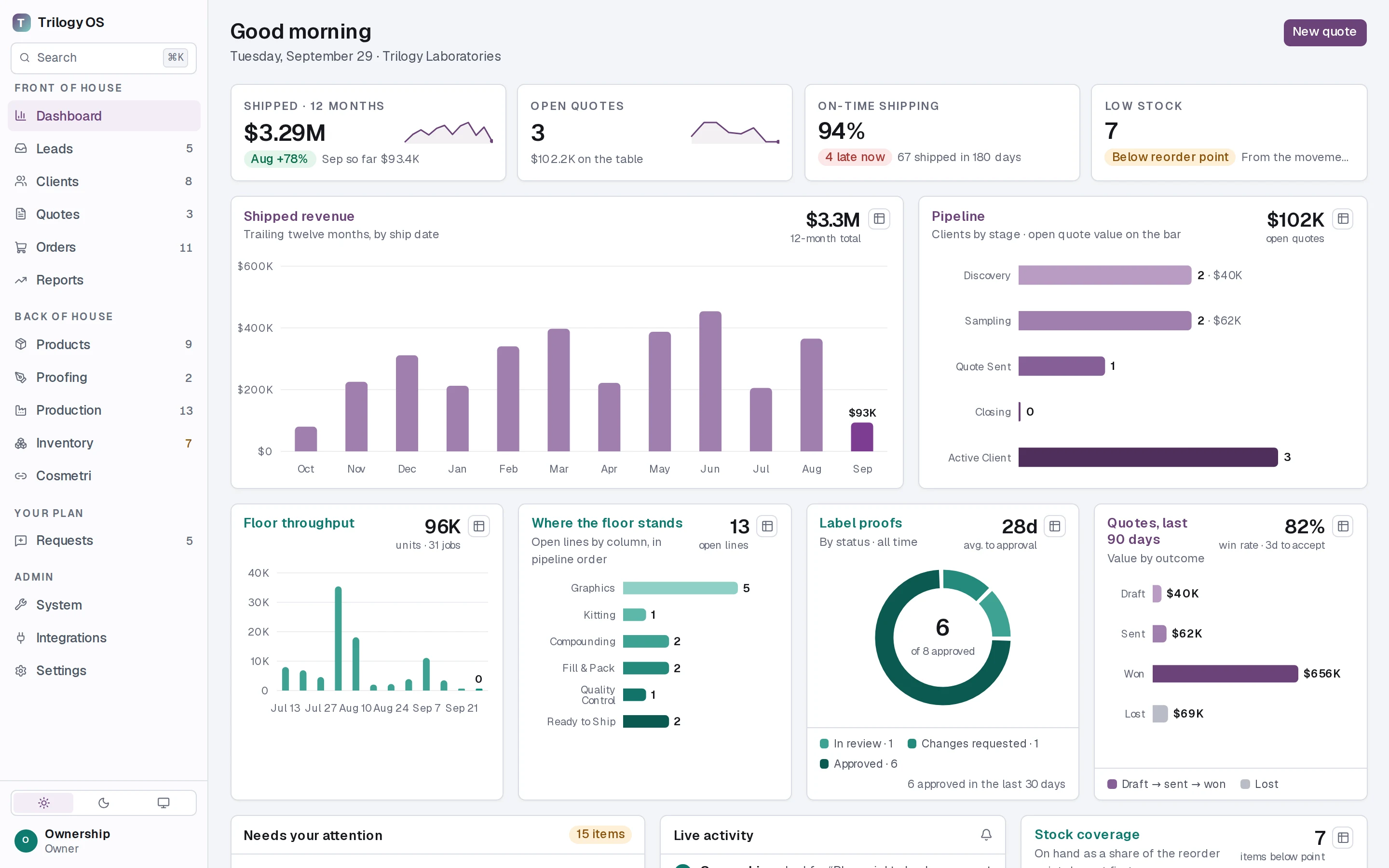
Dashboard and reportsOwnership tiles and charts; reports on revenue, top clients and products, quotes, proofs, throughput, and which lead sources turn into shipped revenue; and a floor-first view for production that leaves out the money.
Production boardThe production workflow, rebuilt with the stage names the floor already uses: one card per order, rush flags, a close-up with the full history, a note on every move, and printable job sheets.
An optional rule holds printing until the label proof is approved.
Label proofing roomVersioned proofs with pinned comments, zoom and a three-way sign-off across regulatory review, the client and production.
Every approval is recorded against the exact version approved.
Lot and sample logA lot number on every order line and every sample shipment, printed on invoices and packing slips for the in-house brands.
One search answers who received lot X, samples included, instead of calling customers to read the bottom of the bottle. Recorded going forward from go-live.
R&D boardDiscovery, formulation, stability and the remaining stages as a drag-and-drop board, with files and photos attached to each project.
Security and rolesRole-based access that mirrors the permission profiles already used in Cosmetri, an audit trail on every record, and nightly backups with monitoring.
Access rules are enforced in the database itself, not only on screen. Formulas are never stored; the system references Cosmetri and nothing more.
Migration, training and go-liveClients, catalog, price sheet, open orders and the contact list imported and validated twice.
Live training for each role, recorded walkthroughs and quick guides, and two go-live waves with a 30-day warranty after each. HubSpot stays read-only for two weeks, then can be cancelled at its renewal.
Learn more about Phase 1
See a client recordInteractive: one record per brand, with its quotes, orders, approvals and lotsShowHide
See how a quote checks minimumsPackaging that fits, product and packaging minimums, and price breaks, line by lineShowHide
| Product | Packaging | Units | Unit price | Line total |
|---|---|---|---|---|
Night Repair Cream Retinol line · Cosmetri ref. 1182 | 50 ml airless pumpOpaque only | 3,000 | $7.40 | $22,200 |
Gentle Cleanser Cosmetri ref. 0937 | 150 ml tottle, frosted | 2,400 | $4.10 | $9,840 |
Packaging that fits
Only packaging that fits the product is offered, and rules such as opaque-only are enforced.
Product minimum
Each product's batch minimum is checked against the quantity on the quote.
Packaging minimum
The packaging run is checked on its own, because the two minimums rarely line up.
Price breaks
Breaks apply automatically, and the next one is shown so sales can offer it.
Approval first
Anything below a minimum is approved before the quote can go out for signature.
Screens from the working buildSix real screens, with sample data in place of Trilogy'sShowHide
How Cosmetri fitsCosmetri stays the system of record, and formulas are never stored in Trilogy OSShowHide
Cosmetri stays the system of record
Cosmetri holds formulas, regulatory work and batch records, and Trilogy OS never replaces any of it. In Phase 1 the two systems run side by side, with a Cosmetri reference on every product in the catalog.
In Phase 2, Trilogy OS reads batch identity from Cosmetri: batch, product, date, quantity and status. Never a formula, never a percentage. It connects through the Cosmetri API where Trilogy’s plan includes it. If Cosmetri doesn’t offer API access on Trilogy’s plan, the connection runs on scheduled Cosmetri report exports at the same price, and acceptance is measured against the imported batches. Every update is checked and flagged if it changes, so Cosmetri remains the source of truth.
Trilogy OS keeps operating records and reports. It does not certify anything.
Integrated, never duplicated.
Timeline: ten to twelve weeks, in two go-live wavesWhat goes live when, starting with one scope sessionShowHide
The scope session, the scope letter, the Cosmetri route for Phase 2, and accounts opened in Trilogy's name.
Scope letter within a weekQuoting, orders, invoices, QuickBooks, the production board, the lot and sample log, roles and the first data import.
Spreadsheet quoting retiresLeads, pipeline, the R&D board, the newsletter and the dashboard. HubSpot goes read-only for two weeks.
HubSpot can be cancelled at renewalIt starts with the scope session
One working session before the build begins. It produces three things:
The Phase 1 scope letter, with the limits printed and the five follow-up automations named.
Which Cosmetri route Phase 2 will use: a direct connection if Trilogy's plan includes the Enterprise API, or the batch report import, which works on any plan.
The list of Cosmetri modules in daily use, so nothing Cosmetri already does is rebuilt.
One session, the letter within a week, then the build clock starts.
Full scope, limits and acceptanceWhat is included, the limits, and how each wave is acceptedShowHide
- The module list is the scope. How each screen looks and behaves is refined together during the build, without change orders, and a better approach can be swapped in for listed work of similar size.
- Limits: 150 products, 300 packaging SKUs, five follow-up automations, one newsletter list, and four source files of about 20,000 rows in total, each validated twice.
- Shopify in Phase 1 means the website inquiry forms arrive as leads. Order and stock syncing are not part of this phase.
- Packaging rules and the price sheet arrive from Trilogy in a template WBX provides. WBX validates; Trilogy decides.
- Each wave ends with a walkthrough against a written checklist. Trilogy has 10 business days to review; after a written reminder, silence counts as acceptance.
- Waits on third parties (Intuit's review, email-domain warm-up) or on Trilogy's data move the calendar day for day. Wave 1 can be accepted on the QuickBooks fallback.
- A new module, a new outside connection or new hardware is scoped and agreed in writing before any work starts. Never a surprise.
- Hosting, domain and database accounts open in Trilogy's name at signing, so Trilogy holds every account from day one.
Enhanced Operations and Compliance
Phase 2 deepens what Phase 1 builds: every production order tied to its Cosmetri batch, every lot traced from batch to client and back, and inventory in the platform with barcode scanning. Eight enhancements, six to eight weeks, starting when the team is ready.
Learn more about Phase 2
Try the recall lookupInteractive: trace a finished lot to its batch, its clients and its samplesShowHide
How the eight enhancements fit togetherTwo lay the groundwork, four build on them, two stand on their ownShowHide
How the eight fit together
Two enhancements lay the groundwork. Four build on them, and two stand on their own.
Every production order tied to its batch, and every lot traced in both directions.
One count of what is on the shelf, which reservations, labels and reorders all read from.
Each deepens a Phase 1 module directly, with no prerequisite.
Cosmetri stays the system of record. Trilogy OS reads batch identity from Cosmetri, directly or from its batch report, and never stores a formula.
The eight enhancements in detailWhat each one deepens, what it needs first, and its full scopeShowHide
Cosmetri batch link
Cosmetri's batch records appear in a register inside Trilogy OS, and a production order cannot be created without selecting its source batches. It works with whatever Cosmetri plan Trilogy has.
Full scope
- How it connects: directly, through the Cosmetri API where Trilogy's plan includes it. If Cosmetri doesn't offer API access on Trilogy's plan, the connection runs on scheduled Cosmetri report exports at the same price, and acceptance is measured against the imported batches. The saved batch report takes about a minute to export, daily or weekly.
- A batch compounded since the last import is scanned or typed at the Compounding stage, where the work happens, and confirmed against Cosmetri automatically at the next import.
- Imported fields only: batch number, product, manufacture date, quantity, status, expiry or retest date, Cosmetri reference. Never a formula.
- Each record shows when it was last read from Cosmetri, and is flagged if the batch changes or disappears there.
- Quantities used from each batch are tracked, with a reconciliation view for the production manager.
Lot traceability
Finished lot numbers are generated by the system and traced to their source batches, printed on invoices automatically, with a recall report in both directions.
Full scope
- Lot format agreed at kickoff; lot numbers flow to invoices and packing slips on their own.
- Sample shipments carry generated lots, typed or scanned.
- Which clients received lot X, and which lots went to client Y, exportable for a recall. Going forward only.
Inventory with barcodes
Inventory moves into Trilogy OS with a one-time import from the current tool, a category hierarchy, barcode generation and scanning, and label printing.
Full scope
- One-time import validated twice. Categories configurable: finished goods, packaging, glass, and so on.
- Code 128 barcodes by default. The existing scanner is tested first; the phone camera works as a fallback. Label printers are named and tested by WBX on the floor before Trilogy buys them.
- Counts and adjustments with reasons, low-stock alerts, reorder points and a preferred vendor per item. A QC pass adds the finished lot to stock.
- Raw materials scoped at kickoff; if Cosmetri tracks them, they stay there.
Stock reservations
When an order is confirmed, the system checks stock, reserves the quantity against that order, shows any shortfall and starts a production order from it, all in the Program Manager view. Stock is deducted automatically at kitting and shipment.
Full scope
- Packaging for the order's SKUs is checked at the same time.
- The Program Manager view: every order shown as reserved, short, in production or ready.
Label usage tracking
Barcodes on label rolls are scanned out per order, so label stock for each product is known before a run starts and a job never stalls for missing labels.
Full scope
- Usage is approximate, within a few units; periodic physical counts continue.
- Low-label alerts per product, tied to upcoming production.
Purchase orders and receiving
Packaging reorders go out as purchase orders straight from the low-stock list, and deliveries are received against the order with a scan.
Full scope
- Purchase orders to each item's preferred vendor, emailed from the system.
- Receiving against the order, with short shipments flagged.
Newsletter segments and campaigns
Segments built from real data, such as product family, client status or last order date, and campaigns scheduled to each segment.
Full scope
- Segments update themselves as orders and stages change.
- Open and click reporting per segment and per campaign.
R&D development records
Each development project keeps its brief, every sample round with client feedback, and its stability schedule in one record, so no decision is lost in an email thread.
Full scope
- Formulation rounds reference Cosmetri; no formula is stored.
- Stability reminders on the schedule, and a history of every round.
One phase, one acceptance
Phase 2 is accepted when every production order created after its go-live traces to a Cosmetri batch (on the report route, against the imported batches), and the inventory count reconciles to the imported file plus recorded adjustments.
Starts when the team is readyLimits and what is not includedWhat Phase 2 leaves out, on purposeShowHide
- Which Cosmetri route applies is settled at the Phase 1 scope session. The report route works on Trilogy's current Cosmetri plan; the direct route needs Cosmetri's Enterprise API, which Cosmetri prices separately.
- Barcode hardware is bought by Trilogy from the models WBX names and tests; the existing scanner is tested before anything new is bought.
- Refinement inside the phase is included. Anything outside the item list is agreed in writing before work starts.
- The same acceptance terms as Phase 1: a walkthrough against a written checklist and 10 business days to review.
- Trilogy OS keeps the records and produces the reports; it does not certify. Quality decisions and regulatory work stay with Trilogy's team and Cosmetri.
- Not in Phase 2: exact label counts, a live link to the current inventory tool, backfill of historical lots, and raw-material planning that Cosmetri already performs.
Growth and Intelligence
New capabilities Trilogy does not have today: AI that drafts, checks and summarizes, with a person approving anything written to a client; forecasts from Trilogy’s own order history; and new ways for clients to reach Trilogy and follow their orders. None of it is needed to run the business. Each is chosen on its own.
Learn more about Phase 3
See the AI inquiry assistantIllustrative: an inquiry read, matched to the catalog, and a reply drafted for sales to sendShowHide
We run three med spa locations and want to launch our own line in the spring: a vitamin C serum in a 30 ml airless pump and a gel cleanser in a 150 ml tube. We are thinking 1,500 of each to start. Could you send pricing and a timeline?
| Product | Package | Units | Price tier |
|---|---|---|---|
| Vitamin C brightening serum | 30 ml airless pump | 1,500 | Tier 2 · 1,000 to 2,499 |
| Gel cleanser | 150 ml tube | 1,500 | Tier 2 · 1,000 to 2,499 |
Thank you for reaching out to Trilogy Laboratories.
A vitamin C serum and a gel cleanser both fit our standard product families, and 1,500 units of each clears our batch minimums. A draft quote is attached.
One note: the 30 ml airless carton prints in runs of 2,500. Moving the serum to 2,500 units reaches the next price break and uses the full run. We would be glad to send samples of both this week.
Sales team, Trilogy Laboratories
The eight capabilities in detailWhat each one does and what it builds onShowHide
AI assistance
4 capabilitiesDrafts, checks and summaries, with a person approving every result.
AI inquiry assistant
AI assistanceAn inquiry email or form, including any brief attached, turned into a drafted first reply and quote from the real catalog, price breaks and minimums. Sales reviews and sends every one.
AI label claims check
AI assistanceLabel copy checked in the proofing room for claims that would make a cosmetic read as a drug, flagged for regulatory review before the client approves. It flags; it is not a regulatory opinion.
Weekly operations digest
AI assistanceA short brief to ownership every Monday: what shipped, what is late, what is low, and which quotes are waiting.
Scanned production-sheet search
AI assistanceThe existing scanned production sheets made searchable by product, date, lot or client, with the source page shown. Header fields only, and a person confirms every result.
Forecasting
2 capabilitiesForecasts drawn from Trilogy’s own order history.
Reorder radar
ForecastingClients who are due to reorder, spotted from order history, with outreach drafted for sales to approve. Reads past invoices from QuickBooks, so it is useful from the start.
Packaging and production forecast
ForecastingUpcoming production runs and long-lead packaging needs from order history and the pipeline, so glass and pumps are ordered before they run short. Needs Phase 2 inventory.
Client channels
2 capabilitiesNew ways for clients to reach Trilogy and follow their orders.
Customer order-status link
Client channelsA private link on every order so a client can check status and tracking at any time, without calling or emailing.
Website assistant
Client channelsA chat assistant on the Trilogy website that answers prospects around the clock: product families and packaging, how minimums work, the sample-to-launch process and typical timelines. Serious prospects become leads in the inbox with the full conversation attached. It answers only from content Trilogy approves, never quotes a firm price, never makes skin or medical claims, never mentions other clients' products, and hands anything specific to a person.
How the AI features workOn Trilogy's own accounts, with people in charge of anything a client seesShowHide
How the AI features work
The AI drafts, checks and summarizes. A person decides.
On Trilogy’s own accounts
AI features run on accounts opened in Trilogy’s name, like every other service behind the platform.
People stay in charge
Every draft, flag and summary waits for someone on the team. Anything written to a specific client is approved by a person; the website assistant answers only from content Trilogy has approved.
Chosen one at a time
None of it is needed to run the business. Each capability is added on its own, when it earns its place.
Also available: in-system payments and a client portalTwo larger client-facing additions, priced in the Investment sectionShowHide
Also available
Two larger client-facing additions, each confirmed once the decisions behind it are made.
In-system payments
A payment link on each sales order, with deposits batched daily to QuickBooks, confirmed after a processor comparison.
Client portal
A login for each client brand with order status, proof approvals, shared documents and reorder requests, each brand walled off from the others.
Plenty of shops can produce software now. Very few have run the operations side of a private-label skincare manufacturer.
Trilogy OS is built with AI-assisted engineering, and that saving is in the price. What Trilogy pays for is the part AI does not shorten:
Knowing the business
How a private-label skincare manufacturer actually runs: minimums on product and packaging, packaging compatibility, proof sign-off, Cosmetri batches, lot recalls. Most developers would be learning this on Trilogy's time.
Trilogy's rules and data
The price sheet, packaging rules and minimums encoded and checked against real quotes; clients, catalog, open orders and contacts moved and validated twice.
Connections that hold
QuickBooks Online and Cosmetri connected without disturbing month-end, and kept working as those services change.
A team that uses it
Every role trained across two go-lives, with recorded walkthroughs and quick guides.
One accountable person
The same person who designed it answers when something needs fixing, and knows why it was built the way it was.
Learn more
How it fits with the systems Trilogy keepsOne application, used from the office and the floor, connected to QuickBooks, Cosmetri, the website forms and emailShowHide
One login per person, one set of screens, and every part of the business working from the same records.
Each of these stays in place. Trilogy OS connects to them; it does not replace them.
What a screenshot never showsAccess rules, a permanent audit trail, tested backups, monitoring, and accounts in Trilogy's nameShowHide
Each person sees what their role needs, set up to mirror the permission profiles Trilogy already uses in Cosmetri.
What it prevents: pricing, margins and client records open to people with no reason to see them.
Every record keeps who changed what, and when. History is added to, never edited or erased.
What it prevents: a question about who changed an order or a lot that nobody can answer.
Access rules live in the database itself, not only on the screen, so a hidden button is never the only lock.
What it prevents: someone reaching a record through a route the screen never offered.
Everything is backed up every night, and restores are practiced so there is proof the backups come back.
What it prevents: discovering on a bad day that a backup never worked.
Quantities, dates, prices and lot numbers are checked as they are entered, before they are saved.
What it prevents: a typo quietly turning into a wrong quote, order or count.
Quoting math, price breaks, minimums and the QuickBooks connection are checked by tests every time the platform changes.
What it prevents: an improvement in one place quietly breaking something in another.
Errors, slow pages and failed connections alert WBX, usually before anyone at Trilogy notices.
What it prevents: a stalled QuickBooks connection going unnoticed until month-end.
Hosting, domain, database and email accounts in Trilogy's name from signing, and full source code at every acceptance.
What it prevents: being locked in to one vendor, or cut off from Trilogy's own system and data.
Honest by designTrilogy OS keeps records and reports; it does not certify, and Cosmetri stays the record for batchesShowHide
Trilogy OS keeps records and produces reports. It does not certify anything, and Cosmetri stays the system of record for batches. What the platform adds is a clean, searchable history of every client, order and lot.
None of this shows up in a screenshot. It is the difference between software that demos well and software a manufacturer runs on.
Why not rent it off the shelf?
Rented tools can cover pieces of this, a CRM here and an inventory tool there. None of them offers the way Trilogy actually works out of the box.
Everyone gets a seat
Today, every HubSpot seat costs $45 to $100 a month, so access gets rationed. In Trilogy OS the whole team gets a login, and each role opens to the part of the system built for its work.
Sales
Leads, clients, quotes and orders, and sends invoices directly
Program management
Orders and proof status, plus the Program Manager view (Phase 2)
Production floor
The production board and job sheets, in a floor view with no pricing
Print and labels
The proofing room, plus label usage tracking (Phase 2)
R&D
The R&D board, plus development records (Phase 2)
Regulatory
Proof sign-off, and the lot and sample search
Ownership
The dashboard and reports, across the whole business
Role-based access is what makes this safe: everyone gets a seat without seeing pricing, margins or formulas they don’t need.
And none of them does this out of the box
- Packaging compatibility rules per product, so a quote only offers packaging that fits Phase 1
- Product and packaging minimums flagged on every quote, with approval required to go ahead Phase 1
- One record from the first inquiry to the shipped lot Phase 1
- A production board built on the stage names the floor already uses Phase 1
- One search for who received lot X, samples included Phase 1
- Production orders tied to their Cosmetri batches Phase 2
- No per-seat or per-contact fees, however many people Trilogy adds Every phase
In Trilogy OS, each of these is scoped work at a fixed price, set out in the next section.
What the rented alternatives would cost (estimates)HubSpot, an inventory and traceability tool, Odoo and NetSuite, at published September 2026 prices, monthly and yearlyShowHide
HubSpot Professional, Sales and Marketing
Marketing and sales software, rented per seat and per contact
Estimate: Sales Hub and Marketing Hub Professional, six users, 8,000 marketing contacts
Every HubSpot seat costs $45 to $100 a month, so access gets rationed. In Trilogy OS the whole team gets a login.
- Marketing Hub Professional is $800 a month on annual billing ($890 monthly), with 3 seats and 2,000 marketing contacts.
- Reaching 8,000 contacts takes two 5,000-contact blocks, about $450–$500 a month. Six Sales Hub Professional seats at $90–$100 add $540–$600 a month.
- Seating the whole team, about six more people across the floor, print, R&D and program management, adds $270–$600 a month: roughly $2,050–$2,600 a month, or $24,500–$31,000 a year.
- Every additional 5,000 marketing contacts adds about $225–$250 a month, and the Professional tiers require an annual commitment. Trilogy OS has no per-seat or per-contact fees, and its plan runs month to month.
Katana, with lot traceability
Rented inventory and production software, usually paired with a CRM such as HubSpot
Core plan plus the traceability add-on, unlimited users
- The Core plan is $299 a month with unlimited users and barcode scanning. Batch and lot traceability is a $249-a-month add-on. Optional onboarding is $2,000.
- MRPeasy Professional (lot tracking, barcodes, quoting and a light CRM) is $69 per user: about $828 a month, or $9,900 a year, for twelve users.
- SOS Inventory Plus is $139.95 a month with 3 users, plus $25 per extra user: about $365 a month, or $4,400 a year, for twelve. Cin7 Core runs $349–$599 a month for five to ten users.
Odoo, partner-implemented
An all-in-one business suite, set up by an implementation partner
Estimate: twelve users on the Custom plan, which adds Studio and API access
- Standard is $24.90 per user a month on annual billing ($31.10 monthly). Custom is $49.00 ($61.10 monthly) and adds Studio, its customization tool, and the API access a Cosmetri link would need.
- US partners charge $100–$200 an hour. Implementation for a small manufacturer runs about $5,000–$20,000.
- Published all-in budgets for small and mid-size companies run $15,000–$60,000.
NetSuite
Oracle’s enterprise business suite, priced by quote
Estimate: twelve users, before add-on modules
- A base license near $999 a month, plus $129–$199 per user a month.
- Implementation: starter packages run $25,000–$35,000, and $25,000–$75,000 is a common range.
Estimates for Trilogy’s whole team of about twelve, except where a card says otherwise. Sources: the published pricing pages of HubSpot, Katana, MRPeasy, SOS Inventory and Odoo; pricing guides from EmailVendorSelection (HubSpot), StackScored (Cin7), ERP Scorecard and Folio3 (NetSuite), and US Odoo partner guides. Researched September 2026. List prices change, and none of these figures is a vendor quote.
The numbers, in one place
Three phases with a price on each, a monthly plan in two levels, and hosting at cost. Signing commits Trilogy to Phase 1. The plan runs month to month from the second go-live. Everything else is bought when it starts.
Fixed price · ten to twelve weeks · $12,250 at signing, then $6,125 at each wave's acceptance
Eight enhancements as one package · six to eight weeks · half at kickoff, half at acceptance
Eight items from $900 · 10% off three, 15% off five · all eight $11,900
Two plans, month to month from the second go-live: Standard $1,450 or Partner $3,750
Hosting, email sending and AI usage
Accounts in Trilogy's name, billed by the providers, no markup · about $75 to $200 a month, plus $35 to $110 once AI items run
Year one estimate, with Standard
$41,900
Year one estimate:Phase 1 at $24,500 and twelve months of the plan: $41,900 with Standard, or $69,500 with Partner, plus hosting at cost. The plan runs month to month after that, with 30 days’ notice.
HubSpot's sales and marketing subscriptions, and spreadsheet quoting.
Phase 2 and Phase 3 prices held from signing, so waiting costs nothing.
Every person on the team gets a login, with a view built for their job. No per-seat, per-user or per-contact fees.
Phase 1: how payment works
Half at signing, then a quarter as each go-live wave is accepted. Each payment follows work Trilogy has already seen and approved.
Phase 1, fixed price
Ten to twelve weeks, two go-live waves
Owned on the final payment.Full source at every acceptance, and every account in Trilogy’s name from signing.
The scope session comes first, included in the price, with the scope letter within a week. If Trilogy withdraws before signing off the scope letter, the signing payment is refunded less a flat $1,500.
The Trilogy OS Plan: two ways to keep it growing
The plan keeps the platform running and improving after go-live. Standard covers the platform. Partner adds someone on the floor every week and new features every quarter.
Standard
$17,400 a year
Keeps it running and improving
- Fixes, whenever something stops working or does not work as accepted
- Monitoring, nightly backups with restore drills, and security updates
- QuickBooks, Cosmetri, website-form and email connections kept working
- Small improvements, shipped in a weekly update
- One larger improvement each month, chosen by Trilogy's approver
- The Requests page, with a monthly changelog of what shipped
- Support next business day
- New features are quoted, or chosen from the Phase 3 menu.
Year one estimate with Phase 1: $41,900
Partner
$45,000 a year
On the floor every week, and in the platform
- Everything in Standard
- On site every week: one four-hour visit, 16 hours a month, for printing, the production floor, training or platform work
- One to two new features each quarter, Phase 3 items or the equivalent, chosen at a quarterly roadmap session
- Same-day priority support
- More time on site can be arranged whenever it is needed
Year one estimate with Phase 1: $69,500
Why Partner makes the most sense
Most of a platform’s value is earned after go-live, on the floor, where the work happens.
Standard keeps Trilogy OS running and improving from a distance. Partner puts the person who built it in the building every week, while the team is learning it and while there is the most to gain.
The first year decides how well it sticks
Go-live changes how everyone works. A weekly visit means questions get answered at the workstation, habits form the right way, and the platform is tuned to what the floor actually does, not what a ticket describes.
Print and production know-how, on site
WBX has stood up in-house label printing and design operations in private-label skincare. Partner brings that experience to the floor every week: label printing, workflow, and training new staff.
Phase 3, included over time
One to two new features every quarter, chosen together at a roadmap session. Over a year or two that covers most of the Phase 3 menu without a separate purchase.
One accountable partner
Same-day priority support, and one person who knows both the operation and the platform. Improvements come from seeing the work first-hand, not from a queue.
What the extra $2,300 a month buys
192 hours
on site each year, one half day every week
4 to 8
new features a year, worth about $7,000 to $14,000 at Phase 3 prices
Same day
priority support, from the person who built the system
Take the value of the features out, and a half day on site every week works out to about $70 to $110 an hour: less than a single hire, with someone who already knows Trilogy’s operation and its platform.
What Each Term Means
Fix
Something stopped working, or does not work the way the accepted checklist says. Also security updates and keeping connections working when those services change. A fix never adds anything.
Both plansImprovement
A change within a module that already exists: a new field, report, view, rule, automation or layout.
Both plansNew feature
A new capability: anything the size of a Phase 3 item or bigger.
Quoted, or one to two a quarter on PartnerPlan termsMonth to month, response times, and how Partner visits and features workShowHide
- It starts when the second go-live is accepted. The plan runs month to month with 30 days' notice.
- Switch plans in either direction with 30 days' notice.
- Prices are held for the first twelve months. After that, any increase is capped at 5% a year.
- Response times are business-hours targets: next business day on Standard, same day on Partner. If the system is down or work is stopped, the response is the same business day on both plans.
- The plan does not increase when Phase 2 or Phase 3 items go live.
- Partner: the weekly visit is scheduled in advance, with travel included, and more time on site can be arranged when a project calls for it. New features are chosen at the quarterly roadmap session; anything larger than the largest Phase 3 item counts as two, the client portal and in-system payments stay priced separately, and an unused pick carries over one quarter.
- Anyone on the team can submit a request on the Requests page. Each one is tagged within a business day as a fix, an improvement or a new feature, so what the plan covers is never a surprise.
Details by phase
Phase 2: the package and what each enhancement costs$12,500 for all eight, against $15,600 bought separatelyShowHide
Cosmetri batch link
Deepens Production board
Lot traceability
Deepens Lot and sample log · needs the Cosmetri integration
Inventory with barcodes
Deepens Catalog
Stock reservations
Deepens Orders and invoices · needs inventory
Label usage tracking
Deepens Production board · needs inventory
Purchase orders and receiving
Deepens Inventory · needs inventory
Newsletter segments and campaigns
Deepens Newsletter
R&D development records
Deepens R&D board
All eight, bought separately
$15,600The package
- Six to eight weeks
- Price held twelve months from signing
Phase 3: item prices, and build your own listFrom $900 an item; 10% off three, 15% off five, all eight for $11,900ShowHide
AI inquiry assistant
A drafted first reply and quote for each inquiry. Sales reviews and sends.
AI label claims check
Label copy checked for drug-like claims and flagged for regulatory review.
Weekly operations digest
A short brief to ownership every Monday.
Scanned production-sheet search
Existing scanned sheets searchable by product, date, lot or client.
Reorder radar
Clients due to reorder, with outreach drafted for sales.
Packaging and production forecast
Long-lead packaging ordered before it runs short. · needs Phase 2 inventory
Customer order-status link
A private link on every order for status and tracking.
Website assistant
Answers prospects on the website around the clock and hands serious ones to sales as leads.
Your Phase 3 list
Nothing added yet. Add items to see the total. The bundle rule applies on its own, and no list ever costs more than all eight.
Saved on this device only. Choosing here commits to nothing.
Priced separately
Larger client-facing additions, each confirmed once the decisions behind it are made.
In-system payments
A payment link on the sales order, with bank transfer preferred and a daily batch to QuickBooks. Confirmed after a processor cost comparison; the QuickBooks flow stays as the fallback.
Client portal
A login for each client brand with order status, proof approvals and reorder requests, with every brand's records walled off from every other.
AI usage at cost.AI features run on Trilogy’s own accounts and bill at cost, like hosting: about $35 to $110 a month once AI items are running. Anything written to a specific client is approved by a person; the website assistant answers only from content Trilogy has approved.
Payment terms and how long these prices holdWhen each part is paid; prices valid through October 30, 2026ShowHide
How each part is paid.Phase 1: half at signing, then a quarter at each wave’s acceptance. Phase 2: half at kickoff, half at acceptance. Phase 3 items: when each one starts. The plan: monthly, from the second go-live. Invoices are paid by bank transfer.
Prices in this proposal are valid through October 30, 2026. Phase 2 and Phase 3 prices are then held for twelve months from signing.
Terms, in plain English
The terms that matter most, in plain words. Open them any time; the services agreement from WBX Creative LLC carries the full wording.
Read the ten termsOwnership and no lock-in, acceptance, refinement, warranty, payments, and what is out of scopeShowHide
Ownership, and no lock-in
Once each phase is paid, Trilogy owns the code for its platform, with full source delivered at every acceptance and every account (hosting, domain, database, email) in Trilogy's name from signing. Ownership is not exclusive: WBX keeps the right to reuse its general building blocks and know-how in other work, but never Trilogy's data, pricing, rules or branding. Documentation and a written handover guide come with go-live, so any competent developer could take the system on.
Acceptance
Each wave, and Phase 2, ends with a walkthrough against a written checklist drafted at the scope session. Trilogy has 10 business days to review. A fix-it list names checklist items that do not work as written; new ideas go to the Requests page. After a written reminder, silence counts as acceptance.
Refinement, during the build and after
Fixed prices buy outcomes. How things look and behave is refined together during the build, with no change orders, and a better approach can be swapped in for listed work of similar size. After go-live, fixes are included on every plan level, improvements on Standard and Partner, and new features are quoted or, on Partner, included one to two a quarter. A new module, outside connection or hardware is quoted in writing first. No surprise invoices.
30-day warranty per wave and phase
Anything that does not work as the accepted checklist describes, found in the first 30 days after that go-live, is fixed free, whether or not Trilogy is on the plan.
Payments, and ending early
Invoices are paid by bank transfer. A late invoice has a 15-day cure; after that, support pauses until it is settled. Access to the platform and its data is never switched off. Either side can end the engagement with 30 days' written notice: accepted waves are paid at their scheduled amounts, work in progress at $175 an hour, and everything paid for is delivered.
Going forward only
No backfill of historical orders or lot data. The system is clean as of go-live, and a few early reorders get typed in by hand.
Formulas stay in Cosmetri
Trilogy OS never stores a formula or an ingredient percentage. It reads batch identity from Cosmetri, through its API where Trilogy's plan includes it, and references product identifiers only. If Cosmetri doesn't offer API access on Trilogy's plan, the connection runs on scheduled Cosmetri report exports at the same price, and acceptance is measured against the imported batches. Cosmetri remains the system of record for regulatory and batch work; Trilogy OS integrates with it and never replaces it.
Responsibilities
Trilogy remains responsible for its regulatory compliance; Trilogy OS keeps records and reports, and does not certify. AI features flag and draft. Anything written to a specific client is approved by a person; the website assistant answers only from content Trilogy has approved. The services agreement sets out liability and the remaining terms.
Out of scope, on purpose
Google Ads and SEO management, a native App Store app, a live link to the current inventory tool, exact label counts, and automated retrieval of scanned records without a person checking.
Mutual confidentiality
Each side keeps the other's information confidential: Trilogy's data, pricing and processes, and the pricing in this proposal.
What WBX needs from TrilogyThe price sheet, catalog, packaging rules and photos, the HubSpot export, and system accessShowHide
What WBX needs from Trilogy
- The full price sheet with price breaks
- The catalog and packaging list with minimums
- Product-to-packaging compatibility rules, in the WBX template
- Packaging photos
- The HubSpot contact and workflow export, and its renewal date
- Administrator access to QuickBooks Online, the Shopify store and Cosmetri
- An export from the current inventory tool, when Phase 2 starts
The working build uses placeholder minimums and prices. Everything above replaces them before the first wave.
Ready to proceed?
When Trilogy is ready to move forward, send Weston an email. He’ll reply with the services agreement from WBX Creative LLC, and the scope session is scheduled once it is signed.
Or write directly to weston@wbxcreative.com
Prices valid through October 30, 2026. Phase 2 and Phase 3 prices are held for twelve months from signing.
Prepared exclusively for Trilogy Laboratories, LLC by WBX Creative LLC · Confidential